Gagan Saini
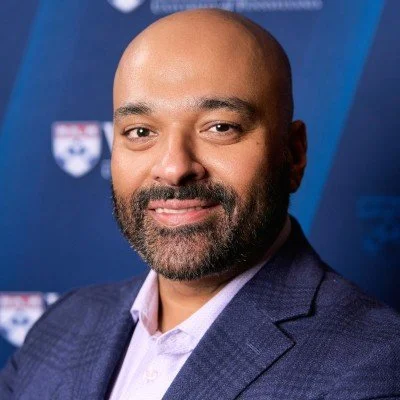
Gagan Saini
Director, AI, Emerging Tech and Innovation- Russell Reynolds Associates
For Gagan Saini, executive search was never the original destination—it was an industry he discovered while exploring where innovation and product development could create meaningful impact.
Before entering the world of executive search, Gagan spent years working across product development in multiple industries, including financial services and legal services. Throughout that time, he became increasingly interested in sectors with deep historical data, specialized expertise, and opportunities for technological transformation.
That curiosity eventually led him to executive search.
As he explored firms like Russell Reynolds Associates, Gagan became fascinated by the scale of institutional knowledge and decades of data accumulated within the industry. He saw an opportunity to build innovative products and systems that could modernize how search firms operate and solve complex business problems for global clients.
“I had no idea before I came across executive search,” Gagan shared. “But I realized there was a lot of exciting work happening here.”
What initially started as a product and innovation challenge quickly evolved into a long-term career. More than 14 years later, Gagan continues to lead innovation initiatives at Russell Reynolds, helping shape how AI and emerging technologies are transforming executive search and talent intelligence.
Throughout his journey, he has played a key role in driving product innovation, predictive analytics, and enterprise AI adoption—well before AI became the industry-wide conversation it is today.
What Shaped His Leadership Philosophy
Gagan credits several leaders throughout his career for shaping the way he approaches innovation, collaboration, and team leadership.
One of the earliest and most influential was Kathleen, a former CIO at Russell Reynolds Associates.
When Gagan joined the firm, one thing immediately stood out to him: many members of the technology organization had remained with the company for over a decade. Curious about the unusually low attrition, he asked Kathleen what she believed was the “secret sauce.”
Her answer left a lasting impression.
Kathleen believed that people stay when they continuously have opportunities to work on the latest and greatest technologies. Rather than allowing employees to feel their skills might become outdated over time, she intentionally created an environment where innovation and cutting-edge work were always part of the culture.
That philosophy deeply influenced Gagan’s own leadership style.
Today, he encourages his teams to balance day-to-day responsibilities with innovation-focused “pet projects,” creating space for experimentation and creativity alongside operational work.
He also credits his current CIO, Preet, for teaching him the power of cross-functional collaboration at an entirely different level.
Watching Preet bring together diverse stakeholders across the organization showed Gagan that even highly technical initiatives benefit from broad perspectives and collaborative decision-making.
That experience expanded his own approach to leadership and reinforced the value of bringing multiple viewpoints into complex product and AI discussions.
Another influential mentor was Mark DiCello, who helped sharpen Gagan’s attention to detail within product development, particularly around user experience, interface design, and data movement.
Gagan admired Mark’s ability to remain highly detail-oriented while still empowering teams with autonomy and ownership—something he continues to model in his own leadership approach today.
Together, those experiences shaped a leadership philosophy centered around innovation, collaboration, continuous learning, and empowering teams to experiment and grow.
How Recruiting Is Evolving
Having worked in AI and predictive technologies since as early as 2016, Gagan has had a front-row seat to the evolution of artificial intelligence long before the recent explosion of large language models.
Early in his AI journey, much of the work focused on predictive engines, analytics platforms, and opportunity dashboards. While those systems showed promise, adoption often remained limited because many organizations still lacked confidence in AI-driven decision-making.
That changed dramatically with the rise of large language models and platforms like OpenAI beginning in 2022.
According to Gagan, the shift in adoption has been unlike anything he has seen before.
At Russell Reynolds, the company launched an enterprise-wide OpenAI platform that achieved adoption rates exceeding 80% within just a few months—far faster than most enterprise technologies typically achieve.
What surprised him most was not only the speed of adoption, but the enthusiasm employees showed toward learning and experimenting with AI tools.
“People were coming to us asking for training,” he explained.
For Gagan, that level of excitement represents one of the biggest shifts in the industry: organizations now see AI as both accessible and transformative.
At the same time, he believes the rapid enthusiasm around AI has also created new challenges.
One of the biggest concerns, in his view, is that many organizations are beginning to treat AI as a “magic wand” capable of solving every business problem.
As a result, leaders are increasingly making AI-related decisions without always fully understanding where AI is—and is not—the right solution.
Gagan believes one of the most important responsibilities for technology and talent leaders moving forward will be educating organizations on when AI genuinely adds value versus when other solutions may be more appropriate.
In his view, successful AI adoption requires strategic thinking, realistic expectations, and a deep understanding of business problems—not simply implementing AI for the sake of it.
Gagan’s Advice for Talent Leaders in 2026
Looking ahead, Gagan believes talent and technology leaders must balance excitement around AI with thoughtful decision-making and practical execution.
While AI has dramatically accelerated innovation, improved adoption rates, and opened new possibilities across recruiting and executive search, he cautions organizations against assuming every challenge requires an AI-driven solution.
Instead, leaders need to focus on understanding the actual business problem first before deciding whether AI is the right tool to solve it.
He also believes organizations must invest more heavily in education—not just for employees, but for executive leadership teams making strategic decisions around AI implementation.
For Gagan, the future belongs to leaders who can bridge technology expertise with business strategy and collaborative leadership.
As AI continues reshaping executive search, recruiting, and enterprise operations, he sees enormous opportunity for organizations willing to innovate responsibly while keeping people, process, and long-term impact at the center of decision-making.
That combination of forward-thinking innovation, collaborative leadership, and deep expertise in AI transformation is what makes Gagan Saini a standout leader in executive search technology—and a deserving member of the Talent 100.
